

For over a century, medicine has offered patients two primary solutions: take a pill or get surgery. This approach has served us remarkably well:
- antibiotics cure infections
- blood pressure medications prevent heart attacks
- surgical procedures can replace organs, worn joints, or remove tumors
But for millions of patients living with genetic diseases, this traditional toolkit falls short.
Consider Malachi, born with spinal muscular atrophy, a genetic condition that gradually destroys the motor neurons controlling her muscles. No pill can supply the missing gene his cells needed to survive. No surgery can repair the genetic instructions written into every cell of her body. By 8 weeks he was not hitting the milestones and at 3 months had no reflexes. The traditional medicine offered only supportive care. His parents would watch him slowly deteriorate over the next 6 to 12 months, until he eventually stops breathing.
Today, Malachi is a 10-year old boy who received a single gene therapy treatment that rewrote his medical destiny.
Malachi’s transformation represents something unprecedented in medical history. It is the ability to cure the cause of a genetic disease, rather than simply managing the symptoms. Welcome to the age of therapeutic revolution. We are moving beyond the limitations of pills and surgery. We are embracing precision treatments that can edit genes and silence harmful proteins. These treatments can also restore cellular ecosystems and deliver therapeutic instructions directly to diseased cells.
Where Traditional Medicine Hits Its Limits
The Symptom Management Trap
Traditional pharmaceuticals excel at managing symptoms but struggle with root causes, particularly genetic diseases. Consider these limitations:
- Sickle cell disease patients take dozens of medications daily and require frequent blood transfusions, but no pill can fix the genetic mutation causing their red blood cells to sickle
- Duchenne muscular dystrophy patients receive physical therapy and breathing support, but no intervention can provide the missing dystrophin protein their muscles desperately need
- Rare disease patients face a stark reality: 95% of the 7,000+ known rare diseases have no FDA-approved treatments
The Economics of Impossibility
Traditional drug development requires massive patient populations to justify billion-dollar development costs. Rare diseases affecting thousands (fewer than 1 in 2000 people in any WHO region) rather than millions of patients simply do not fit the economic model of conventional pharmaceuticals. It is just too expensive to develop and get regulatory approval for a drug which will be used by a small number of patients.
The Surgical Limitation
Surgery can repair damage, replace organs, and remove diseased tissue—but it cannot:
- Correct genetic programming errors
- Restore missing cellular functions
- Prevent progressive genetic conditions
- Address diseases affecting every cell in the body
When Hope Meets Reality
For families facing genetic diagnoses, traditional medicine often delivers devastating news. They say, “We can make your child comfortable, but we cannot change the outcome.” This represents medicine’s fundamental limitation—treating effects while the underlying causes remain untouchable.
The Four Pillars of Next-Generation Therapeutics
The therapeutic revolution rests on four groundbreaking approaches, each targeting a different level of biological dysfunction:
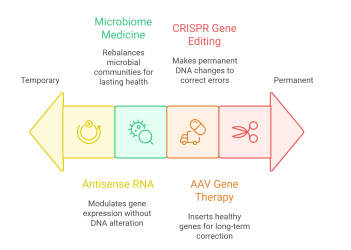
1. CRISPR Gene Editing: Rewriting the Code of Life
CRISPR technology acts as “molecular scissors,” making precise cuts in DNA to correct genetic errors. Unlike medications that temporarily alter cell function, CRISPR makes permanent changes to the genetic instructions themselves.
Real-world impact: Patients with sickle cell disease are experiencing complete elimination of pain crises after single CRISPR treatments. The longest-treated patients now over four years crisis-free.
2. AAV Gene Therapy: Delivering Genetic Instructions
Adeno-associated virus (AAV) therapies use modified viruses as biological delivery trucks to transport healthy genes into specific tissues. These treatments can provide missing genetic instructions that patients were born without.
Real-world impact: Children with spinal muscular atrophy who would have lost the ability to sit, stand, or breathe are now hitting normal developmental milestones after single AAV treatments.
3. Antisense RNA Therapy: Silencing Harmful Genetic Programs
Antisense oligonucleotides (ASOs) work like genetic volume controls. They turn up beneficial genes or turn down harmful ones. This occurs without permanently changing DNA.
Real-world impact: Patients with previously untreatable muscle-wasting diseases are gaining strength and function through precision RNA modifications.
4. Microbiome Medicine: Restoring Biological Ecosystems
Antibiotic treatment kill all bacteria bad and good thus making recovery complicated. Therefore, rather than using antibiotics to kill harmful bacteria, microbiome therapies restore healthy microbial communities. These communities naturally outcompete pathogens. They also support optimal health.
Real-world impact: Patients with life-threatening antibiotic-resistant infections are being cured through fecal microbiota transplants when traditional antibiotics fail. It sounds bad but it makes a live changing difference to the patients.
The Precision Revolution
What unites these approaches is precision. It is the ability to target specific genetic programs, cellular pathways, or biological systems. This precision leaves healthy functions intact. This represents a fundamental evolution from traditional medicine’s broad-spectrum approach to personalized interventions designed for individual patients’ unique biology. We now have ability to move away from one treatment fits all.
What This Series Will Cover
Over the coming posts, we’ll dive deep into each of these revolutionary approaches:
Each post will feature real patient stories. It will explain the science in accessible terms. The posts will also provide information about availability and costs. They will show how to access these breakthrough treatments.
A New Chapter in Medical History
We stand at the threshold of medicine’s next great era. For the first time we can:
- edit the genetic instructions that govern health and disease
- deliver therapeutic genes to specific tissues
- precisely control cellular programs
- restore beneficial biological ecosystems.
This is not theoretical future medicine—these treatments are FDA-approved and saving lives today. Patients once told “there’s nothing we can do” are now experiencing complete cures from conditions that plagued them for decades. And this is just the beginning, there are more novel therapies being developed.
The therapeutic revolution represents hope for the 400 million people worldwide living with genetic diseases. It is also a beacon of hope for the millions facing antibiotic-resistant infections. Additionally, it offers possibilities for countless others whose conditions have been beyond traditional medicine’s reach.
Over this series, you’ll meet the patients whose lives have been transformed. You’ll understand the science making these miracles possible. You’ll also discover how these breakthrough treatments might change medicine forever.
The age of precision medicine has arrived. Let’s explore what it means for human health.
References:
- History of medicine – 20th Century, Advancements, Innovations | Britannica, accessed 23 Aug 2025
- SMA Gene Therapy Zolgensma ‘Saved All of Our Lives’: A Family’s Story, accessed 23 Aug 2025
- How Clinical Research Can Save Lives: The Story of Tina and Malachi Anderson – The Clinical Trials Network, accessed 23 Aug 2025
- Rare Diseases at FDA | FDA, accessed 23 Aug 2025
- The landscape for rare diseases in 2024, Lancet Editorial, accessed 23 Aug 2025
- Pricey new gene therapies for sickle cell pose access test | BioPharma Dive, accessed 23 Aug 2025
- CRISPR gene-editing success for sickle cell raises new questions : Shots – Health News : NPR, accessed 23 Aug 2025
- FDA approves innovative gene therapy to treat pediatric patients with spinal muscular atrophy, a rare disease and leading genetic cause of infant mortality | FDA, accessed 23 Aug 2025
- Spinraza (nusinersen) – Rare Disease Advisor, accessed 23 Aug 2025
- FDA Approves Fecal Transplant Therapy for Recurrent C. Diff, , accessed 23 Aug 2025

Leave a comment