
What is genome editing and what can it do?
Genome editing is a way to modify DNA of an organism to replace, add or remove a specific fragment with a new piece. The technology was invented in 2009 by Doudna and Charpentier (Jinek et al 2012) and made used of CRISPR-Cas9 system. Following this discovery, two other groups described its use in editing a human genome (Cong et al 2013, Mali et al 2013).
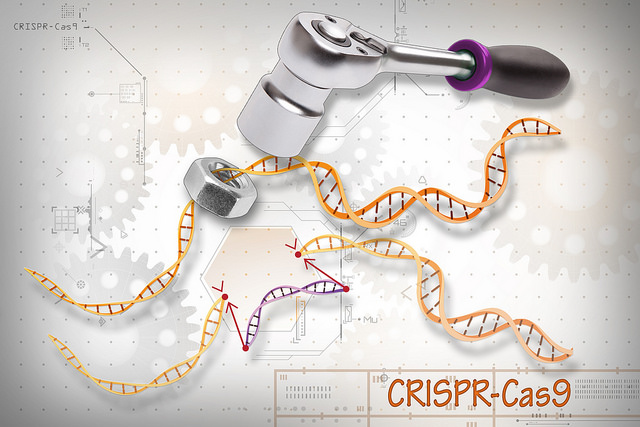
CRISPR stands for Clustered Regularly Interspaced Short Palindromic Repeats. Cas9 is a CRISPR associated protein 9, with RNA-guided DNA endonuclease function. This method is considered to be sequence specific and target only the region of interest. Theoretically, any gene or its fragment can be modified leading to countless possibilities. Initially, the focus has been on using the method in research to generate targeted mutants in plants, animals and cells. It is a much easier way to create models of human disease than making transgenic animals and allows to study various aspects of human diseases. However, it became clear that using CRISPR-Cas9 system can be used for curing genetic disorders by repairing the gene responsible, for example cystic fibrosis (Marson et al 2017). It can also be used as antiviral treatment (Ebina et al 2013).
Credit: McGovern Institute for Brain Research at MIT
While manipulating the sequences is relatively easy, there are some concerns over safety and accuracy of the method. Main issues researchers focused on were potential off-target effects of CRISPR-Cas9 system. While the risks of this are inherent to the technology which relies on short guide RNA molecules of 20bp in length with 8-12bp of the proximal region being said to be especially important. High specificity of 20bp fragments has been demonstrated by years of using polymerase chain reaction (PCR) for gene amplification, however, the shorter fragments of 12bp are much less specific for some sequences. There are a number of computational ways to maximize the correct targeting but it is also clear that not all sites in a genome will be easy targets (Keener 2015 and Wang and Ui-Tei 2017). A publication by Schaefer et al (2017) describing a huge scale of unwanted off-target events has send storm waves around the world. While most researchers concede that some off target events can happen the scale presented in this paper is not believable. Twitter discussion and later various interviews have focused on the methods used in the publication as the cause of the problem. Obviously further work is essential to determine how to eliminate off-target effects.
So how does that affect the future of CRISPR-Cas9 applications in treating human diseases?
Gene editing can definitely cure a number of diseases by introducing corrected versions of the genes into an organism. There are obviously technical challenges that need to be resolved. One of them is clarification of the off-target effects, the other is actual delivery of constructs. Treating patients is very different from introduction of CRISPR-Cas9 constructs into cells and animals in a research lab. Thus far CRISPR/Cas9 system has not been yet attempted in patients. There were attempts by Chinese researchers to modify human embryos (Liang et al 2017). However, an older technology using transcription activator-like effector nucleases (TALENs) has been used this year for treatment of childhood acute lymphoblastic leukemia (ALL) by Qasim et al (2017). This has shown that gene editing can be used for a therapeutic applications.
However, while treating serious diseases, such as cystic fibrosis or ALL is definitely a great thing, there is a potential for using CRISPR-Cas9 in applications that have very little to do with human health and well being. Ethical considerations are an important part of further development of gene editing therapy. Those are related to manipulation of embryos and making inheritable changes in their genomes are of particular interest. While alterations in cells of various tissues (somatic cells) will be limited to the individual treated, changes to human germline in an embryo can be inherited by future generations. Moreover, we cannot predict how such inherited changes will affect not only future of an individual but also human race as such. The most commonly cited objection is fear or potential of creating designer babies.
At this stage we are ready for more research and serious conversations between scientists, clinicians, ethics experts, lawyers and general public as to where the technology is heading. However, we are not yet ready for clinical applications of the technology in embryos.
Another issue that is casting a shadow on the future use of CRISPR-Cas9 system is a fight for patents and uncertain future of licensing of technology, specific applications. However, this is a story for another time. Enough said that patent wars are being fought in the US and Europe with varying success by multiple groups.
References:
Jinek et al (2012) A programmable dual-RNA-guided DNA endonuclease in adaptive bacterial immunity. Science, 337(6096):816-21.
Cong et al (2013) Multiplex Genome Engineering Using CRISPR/Cas Systems. Science, 339 (6121): 819-823
Mali et al (2013) RNA-guided human genome engineering via Cas9. Science, 339 (6121): 823-826
Marson et al (2017) Personalized or precision medicine? The example of Cystic fibrosis. Frontiers in Pharmacology, 8: 1-8
Ebina H et al (2013) Harnessing the CRISPR/Cas9 system to disrupt latent HIV-1 provirus. Sci Rep., 3:2510
Keener, AB. (2015) Delivering the goods: scientists seek a way to make CRISPR-Cas gene editing more targeted. Nature Medicine, 21(11): 1239-41
Wang, Q and Ui-Tei, K. (2017) Computational Prediction of CRISPR/Cas9 Target Sites Reveals Potential Off-Target Risks in Human and Mouse. Methods in Molecular Biology, 1630:43-53
Schaefer et al (2017) Unexpected mutations after CRISPR–Cas9 editing in vivo. Nature Methods, 14: 547–548
Liang et al (2017) CRISPR/Cas9 mediated gene editing in human tripronuclear zygotes. Protein & Cell, 6(5): 363-72
Qasim et al (2017) Molecular remission of infant B-ALL after infusion of universal TALEN gene-edited CAR T cells. Science Translational Medicine, 9 (374)


Leave a comment