
Promising beginnings
The story of 23andMe is full of twists and turns. It started as the first direct-to-consumer (DTC) genomics company. It promoted testing for ancestry, carrier screening and genetic predispositions to a variety of diseases and some health-related conditions.
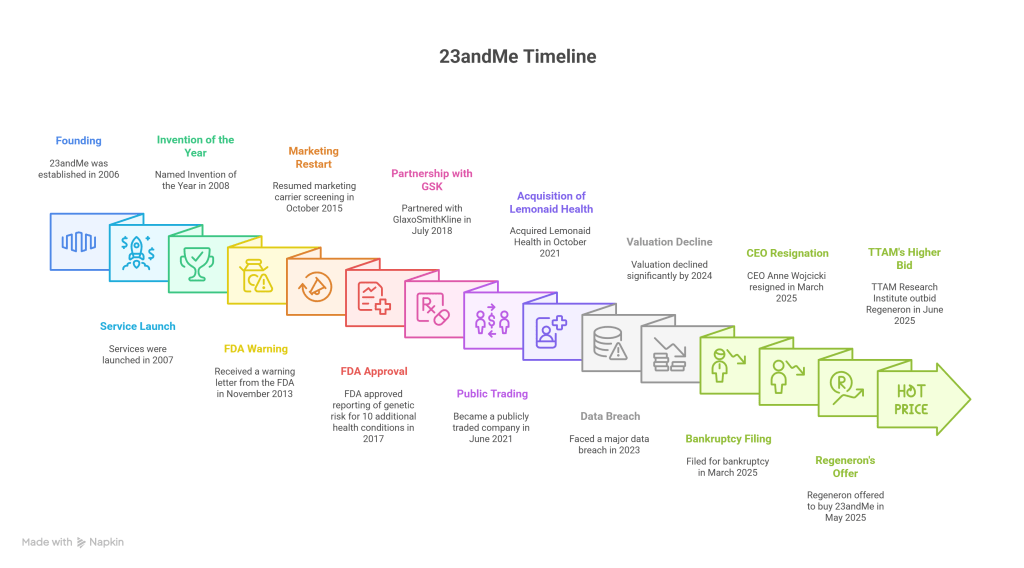
23andMe managed to gain FDA approval for returning some of the health-related results. However, it has been struggling to create a sustainable business model. It seemed that collaboration with pharma companies will help after a few collaborations were signed. Despite layoffs in 2020 due to reduced testing volumes, the company went public in 2021.
The downward spiral
The big problems started with the data breach in 2023. The downward spiral ended up with Anne Wojcicki resigning and company filing for bankruptcy. 23andMe crashed from $US6billion valuation right down to the bottom (23andMe (ME) – Stock price history). That meant that all company assets, including customers’ data and samples would be up for sale. Regeneron made a $256 million bid for 23andMe in May 2025. However, it was outbid by TTAM Research Institute, a non-profit established by Anne Wojcicki. With the final price at $US305 million the 23andMe is once more in the hands of the original co-founder.
What has gone wrong?
The issues 23andMe faced were related to the fact that each of customers had their DNA tested once. by 2024 the company claimed to have genotyped 14 million individuals. Is it a lot or not depends on your point of view. But with the price tag between $99 to $125 a test, this is not a lot of revenue. Subscriptions to receive updates were somewhat helpful to improve revenue.
The true value of the company was the data 23andMe was collecting. In order to capitalize on that 23andMe entered into multiple partnerships with drug companies with Glaxo being the biggest deal. Customers were given an option to opt-out of these research activities instead of opting in. Transparency of collecting consent and sharing the data with third parties left a lot to be desired.
Data breach
The data the company held became even more problematic due to the breach that occurred in 2023. Initially, 23andMe blamed the data leak on the users. However, it became clear that it was not the case. As a result, personal data of 6.9 million users was accessed by hackers. While the class-action lawsuits ended up with a settlement valued at $US30 million, the data is out there. The money cannot restore your data if it was stolen. The data is also irreplaceable. We have no clarity how it can be used.
Saga of the data continues
When 23andMe filed for bankruptcy, customers were advised to delete their data and request the destruction of their DNA samples. Now the problem is that the company can still retain the genetic data for up to three years. This timeline is to comply with the legal obligations as described by CLIA and California regulations. The customers also have to trust that their DNA samples were destroyed.
The entire process how 23andMe used, shared and protected the data raises major questions and issues:
- Failing to provide a clear consent form and process for sharing the data
- Lack of transparency how the data is handled and shared
- Failing to protect sensitive data
- Privacy policy allowing the company to sell customers’ data if the company goes bankrupt, merges or is acquired
While sharing deidentified data with third party is a well-established process, participants must be clearly informed and consent to it. The truth is in 2007/2008 when company operations DTC testing was a novelty. With this came lack of clarity how the data will be used in the future. The company’s plans have evolved over time as it was struggling to create a profitable business.
What does the future hold?
Now the data and other assets belong to the TTAM Institute. What do we know about it? Not much so far, the claims are that they are a non-profit public benefit corporation. TTAM claims that it is committed to provide customers with choice and transparency with regards to their data. It is definitely space to watch. Just as this post was going to publishing, Anne Wojcicki posted a message to the 23andMe community. She has re-iterated that the company stood for something revolutionary. Her belief is that the non-profit medical research institute will be the best way forward.
One has to commend her belief in pursuit to understand how the knowledge of the DNA can benefit us all. The question is, will TTAM resolve the data issues? As these have become an obvious problem for 23andMe over the past few years.
Summary or Lessons Learned
Raise, fall and restart of the 23andMe is an interesting case. When you look at the users/customers, there are lessons we should all have learned by now:
- Direct-to-consumer (DTC) genetic testing needs to be approached with caution.
- Who owns the data generated? Read the privacy statements, consent forms. Do you get the your data?
- Health insights gained from DTC testing are not what they promise to be. So, treat the results with some skepticism, if the results are concerning seek professional advice. DTC tests are not diagnostic.
- DTC genetic tests democratize access of an average person to genetic testing. The low price point, simple sample collection, no need for prescription makes it easy.
- The current raise of genomic testing companies offering whole genome or exome testing, pharmacogenomics testing directly to consumers need to be looked at with the same caution as original DTC testing companies
- We need an easier and more affordable access to the genomic sequencing than is currently offered.
These are not all the lessons that should have been learned from the story of 23andMe. There is an important story for all the startups creating new products and coming to the market. It is critical that there is a clear business plan of how you will reach profitability. Rushing to market without the right market research can cloud the judgment. Lacking knowledge of competition and focusing solely on big deals too early can also affect the outcomes. Plan, research, build and pivot if you need. The technology we have now in diagnostics and biotech/pharma can improve people’s health so let’s get there.
Sources:
- DNA Genetic Testing For Health, Ancestry And More – 23andMe, accessed 15 July 2025
- TTAM Research Institute, A Nonprofit Public Benefit Corporation, Completes The Acquisition of 23andMe Assets | 23andMe, Inc., accessed 15 July 2025
- TTAM Research Institute, accessed 15 July 2025
- Judge OKs sale of 23andMe to a nonprofit led by its founder : NPR, accessed 15 July 2025
- 23andMe has filed for bankruptcy. So what does it mean for customers’ data? – ABC News, accessed 15 July 2025
- 23andMe is on the verge of bankruptcy. It may be too late to delete your genetic data – ABC News, accessed 15 July 2025
- Attorney General Bonta Urgently Issues Consumer Alert for 23andMe Customers | State of California – Department of Justice – Office of the Attorney General, accessed 15 July 2025
- 23andMe’s Fall From $6 Billion to Nearly $0 – WSJ, accessed 15 July 2025
- 23andMe to Be Bought Out of Bankruptcy by Regeneron for $256 Million – WSJ, accessed 15 July 2025
- 23andHim: The Untold Story Of 23andMe’s Third Co-Founder, accessed 15 July 2025
- Drug giant Glaxo teams up with DNA testing company 23andMe, accessed 15 July 2025
- 23andMe lays off 100 people, CEO Anne Wojcicki explains why, accessed 15 July 2025
- Gene testing firm 23andMe trades higher after Branson SPAC merger, accessed 15 July 2025
- 23andMe Will Spend $400M to Acquire Lemonaid Health | HealthLeaders Media, accessed 15 July 2025
- 23andMe to delist from Nasdaq, deregister with SEC, accessed 15 July 2025

Leave a comment